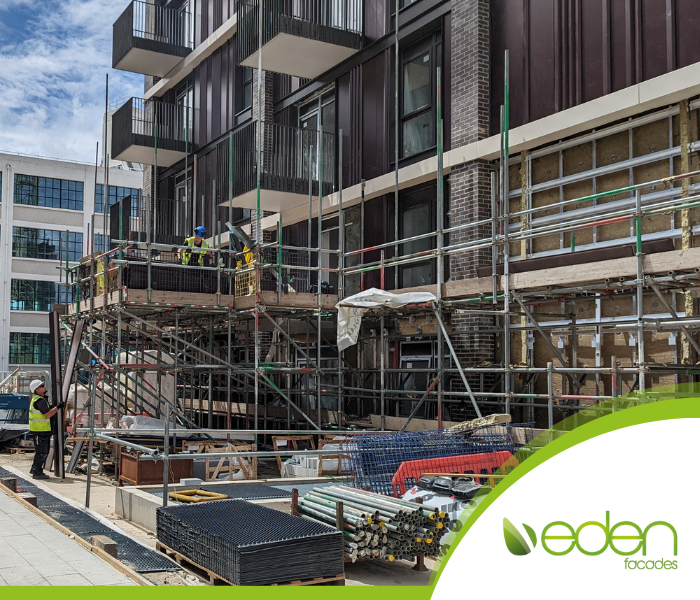
When we look at a building’s facade, the first thing we notice is its appearance – the colour, texture, and how the building presents itself to the world. But facades are far more than architectural finishes; they are critical components of a building’s performance.
A facade forms the building’s first line of defence against external forces such as wind and rain. Yet, it is also a complex, engineered system that must perform under extreme conditions, including during a fire within the building.
This article explores the vital role that facades play in fire safety – preventing ignition, limiting the spread of fire and smoke, protecting escape routes, and maintaining compartmentation.
The facade’s role in the fire strategy
Modern buildings are designed around a holistic fire strategy. Internally, this relies on compartmentation – dividing buildings into fire-resistant zones to prevent fire spreading horizontally or vertically. Externally, the facade forms the interface between these protected compartments and the outside environment.
If poorly designed or installed, facades can:
- Enable rapid vertical fire spread
- Allow fire to re-enter buildings at higher levels
- Compromise internal compartmentation
- Undermine evacuation routes and firefighting efforts
When designed correctly, the facade contains, controls, and limits fire – buying time for occupants to escape and for emergency services to respond.
As Matt Green, Operations Manager at Eden Facades, explains:
“Facade fire safety must work from the inside out. Internal fire compartments, floor-to-floor separation, and apartment boundaries must all be mirrored externally through the facade design. Any weakness in this continuity creates a pathway for fire and smoke.”
Material choice: The first line of defence
Material selection is fundamental. Under current UK regulations, materials used in external walls for high-rise residential buildings over 18 metres must achieve A1 or A2 fire ratings. These materials resist ignition and limit flame spread.
This shift has been one of the most important lessons learned from historic facade failures. One of them is Grenfell Tower, a catastrophe that serves as a reminder of the importance of fire safety in all buildings. Combustible cladding systems can allow fire to travel rapidly and unpredictably across a building’s exterior. Non-combustible materials, by contrast, remove fuel from the equation.
At Eden Facades, we will not specify materials that fall below these standards on any of our projects. Where clients or designers propose higher-risk materials, we actively engage to recommend safer, compliant alternatives that protect both the building and its occupants.
Insulation: Preventing hidden fire spread
Insulation plays a critical role in façade fire performance. Using non-combustible insulation, such as mineral wool, helps prevent hidden fire and smoke propagation behind the cladding while maintaining thermal performance.
Insulation must always be specified and installed as part of a fully tested, non-combustible façade system, rather than considered in isolation.
Cavity barriers: Turning facades into compartmented systems
Ventilated facades, particularly rainscreen cladding systems, rely on cavities to manage moisture and airflow. However, if fire or smoke enters an unprotected cavity, it can spread rapidly and unpredictably, behaving like a chimney and compromising multiple floors in minutes.
Cavity barriers are essential passive fire-stopping devices that subdivide facades into smaller compartments, preventing rapid fire spread and maintaining internal fire integrity, which Eden Facades expertly installs.
In practice, horizontal cavity barriers are installed at each floor level, with vertical barriers located at party wall lines and critical junctions. Many ventilated cavity barriers incorporate intumescent strips that expand when exposed to heat, sealing the airflow gap during a fire while allowing ventilation in normal conditions.
This dual function, ventilation in day-to-day use and automatic closure in a fire, ensures facades can manage moisture safely without creating hidden pathways for fire or smoke spread.
Achieving this level of performance relies on cavity barriers being installed correctly, in strict accordance with tested systems and manufacturer requirements. As approved installers of fire cavity barriers, this gives clients the peace of mind that all our work is carried out in compliance with regulations and to a high standard.
Fixings and substructures: Holding everything in place
Fire safety is not just about stopping flames – it is about maintaining stability.
Facade substructures and fixings must retain their integrity under extreme temperatures. Metal substructures are typically specified because they are less likely to fail during a fire, reducing the risk of facade collapse and protecting both occupants and firefighters.
A facade that detaches or collapses during a fire creates new hazards, blocks escape routes, and complicates firefighting operations. Fire-safe design means ensuring that every component – from brackets to rails – performs as part of a single system.
Openings: reinforcing the weak points
Windows and doors are among the most vulnerable points in any facade. During a fire, glazing can fail, allowing flames and smoke to exit the building and threaten upper floors.
Facade design addresses this through:
- Fire-resistant glazing and spandrel panels
- Fire stopping around window and door openings
- Continuous cavity barriers at heads, sills, and reveals
These measures help prevent fire re-entry, protect escape routes, and maintain compartmentation between floors.
Different systems, different fire risks
Fire strategies vary depending on the facade system:
- Traditional brickwork offers inherent fire resistance but relies on correct cavity detailing.
- Curtain walling systems depend on fire-resistant glazing, spandrels, and floor-to-floor barriers.
- Rainscreen facades require robust cavity barrier strategies due to their ventilated nature.
Whether using brick slips, fibre cement panels, or external wall insulation, the fire strategy must be system-specific and installed in accordance with building regulations and the manufacturer’s specification.
Beyond aesthetics
Facades define how buildings look, but more importantly, they define how buildings perform in a fire. When properly designed, specified, and installed, modern facades play a vital role in limiting fire and smoke spread, protecting escape routes, maintaining compartmentation, and ultimately safeguarding lives.
At Eden Facades, fire safety is not an afterthought. It is embedded in every decision we make, because a facade should never just look safe – it should be secure. With many years of experience delivering a wide range of facade systems, we are well placed to support projects from design through to installation, giving clients confidence that work is carried out correctly and in full compliance from the outset.
If you’re looking for an expert facades sub-contractor who will get the job done right, on time, and in accordance with all regulations, please contact our team.