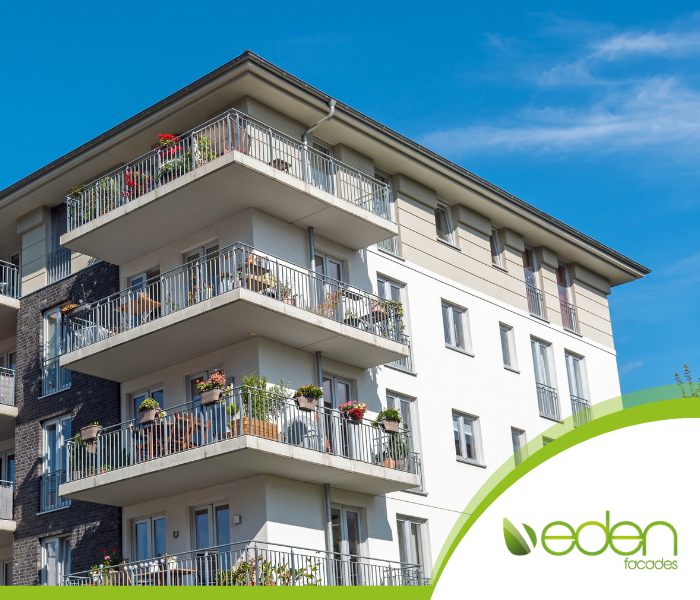
Since the introduction of the Building Safety Act, the industry has sharpened its focus on how fire risk is assessed, managed and regulated. That attention has largely centred on buildings above 11 metres, particularly higher-risk buildings over 18 metres and those requiring cladding remediation.
This has brought greater clarity, funding, and oversight to the built environment, particularly regarding fire safety and façade performance. It has also created a clear boundary – and with it, an important question about how risk is addressed in buildings below 11 metres.
Government policy has consistently maintained that there is no systemic fire safety issue in buildings under 11 metres, and that most do not require the same level of costly remediation.
In this article, we explore why cladding remediation starts at 11 metres, how that threshold shapes the current approach, and why façade safety in lower-rise buildings still deserves careful consideration.
A system built around height
Buildings under 11 metres fall outside the protections introduced under the Building Safety Act, meaning leaseholder protections do not apply, and tools such as remediation orders and remediation contribution orders cannot be used.
Access to government funding is also more restricted, with both the Building Safety Fund and the Cladding Safety Scheme focused primarily on buildings above 11 metres, and with further priority given to those over 18 metres.
The result is a clear difference in how buildings are treated: those above 11 metres have more clearly defined routes for funding, enforcement, and façade remediation, while those below are more likely to rely on existing regulations and case-by-case intervention.
The government’s position
Successive governments have maintained a consistent position on lower-rise buildings.
The previous administration stated that there is “no systemic fire safety issue” in buildings under 11 metres, noting that investigations into specific cases found that the overwhelming majority did not require remediation. This position has been reaffirmed more recently. In September 2024, the government stated:
“The risk to life is usually lower in buildings under 11 metres, and they are very unlikely to need the same costly remediation.”
It has also confirmed that, since 2022, buildings under 11 metres that have been brought to its attention have been investigated, with the vast majority requiring lower-cost mitigation measures rather than full cladding remediation.
Risk, consequence and façade performance
Lower-rise buildings typically present different evacuation dynamics, with easier access for fire and rescue services and shorter escape routes. As a result, the potential consequences of a fire are generally considered lower than in taller buildings.
However, height alone does not determine fire risk – particularly when considering how a cladding system performs in preventing and limiting fire spread.
Risk is influenced by a combination of factors, including occupant vulnerability, building design and compartmentation, façade materials, fire detection systems, and ongoing management and maintenance. The specification, detailing, and installation of façade systems all play a critical role in a building’s fire safety. Combustible cladding systems can allow fire to travel rapidly and unpredictably across a building’s exterior, whilst effective systems, by contrast, remove fuel from the equation and prevent the spread of a fire.
Height provides a useful framework for categorisation, but it does not fully reflect how façade systems perform in practice, as Tony Hill, Managing Director at Eden Facades, explains:
“Height has become a convenient way of categorising risk, but it doesn’t tell the whole story. The performance of a façade system depends on how it’s been designed, specified and installed – and those variables exist on buildings of all heights.”
The data gap and the blind spot
Fire statistics are not typically aligned with regulatory thresholds such as 11 or 18 metres. Even so, official data makes clear that fire risk is not confined to taller buildings. In 2024, 204 of the 263 fire-related fatalities recorded in England occurred in dwelling fires, while fatalities in high-rise flats or maisonettes remained at just two.
That is not to diminish the importance of fire safety in high-rise buildings. The Grenfell Tower fire demonstrated, in the most devastating terms, the consequences of façade system failure in taller residential schemes. It does, however, reinforce that fire risk exists across the full range of residential buildings, including those below the thresholds that currently trigger support for cladding remediation.
With regulatory focus, funding, and industry attention concentrated on high-rise buildings, lower-rise buildings – and the makeup of their façade systems – can be more easily overlooked, despite forming a substantial part of the overall fire risk landscape.
A question of proportionality
The current framework reflects a deliberate prioritisation of buildings where the consequences of failure are greatest.
As cladding remediation progresses, there is an opportunity to consider how risk is distributed more broadly across the built environment, including the performance of existing façade systems on lower-rise schemes.
For buildings under 11 metres, the absence of systemic intervention does not remove the need for careful assessment. Instead, it places greater emphasis on proportionate risk assessment, targeted mitigation and ongoing management to ensure safety.
As Tony adds:
“We’ve seen examples of buildings just below the 11-metre threshold where the condition or detailing of the façade would absolutely warrant closer scrutiny. The cut-off has to sit somewhere, but it shouldn’t lead to an assumption that buildings just under that line are inherently safe.”
What comes next for façade remediation
The industry has made significant progress in addressing higher-risk buildings, particularly through advances in remediation programmes.
Yet while the most visible risks may sit above 18 metres, the performance of façade systems – and the risks associated with them – extend across the full spectrum of residential buildings. Where remediation is needed, safe and effective outcomes depend on a measured approach supported by specialist expertise.
For Eden Facades, practical experience is central to that process. We have delivered cladding remediation projects across a range of building types, helping clients assess existing façades through our intrusive surveys, develop replacement strategies and implement compliant remedial solutions.
As Tony explains:
“The industry has rightly focused on higher-risk buildings, but that should not prevent a closer look at lower-rise schemes where concerns exist. Early assessment and informed intervention can play an important role in managing risk. We work with clients to understand the condition of their façades and deliver remediation strategies that are both practical and compliant.”
Need support with a cladding remediation project? Contact our team to discuss your requirements.