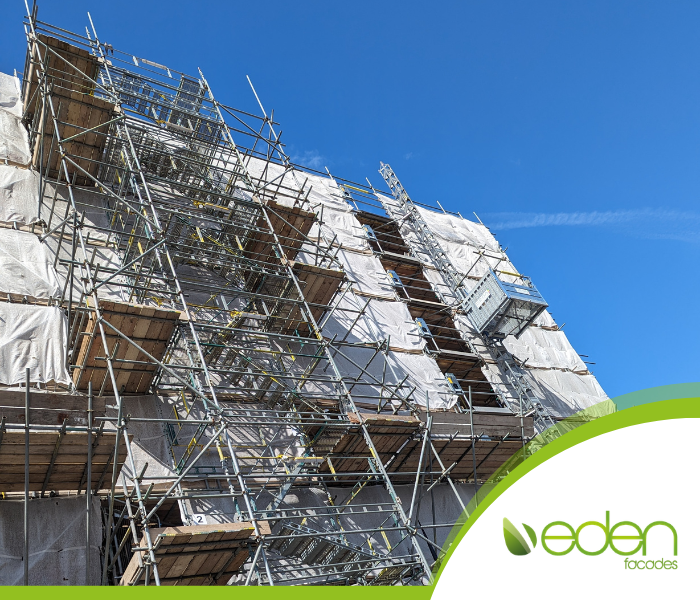
Fire safety is central to façade design and installation. More than an architectural feature, the façade is a system that plays a critical role in protecting people, property, and a building’s overall integrity.
Facade fires in high-rise buildings have increased sevenfold over the last 30 years, averaging 4.8 major incidents reported each year globally. This trend underscores the importance of strict design, specification, and installation standards for fire safety.
In the wake of Grenfell, the industry focused on remedying unsafe façades. Our experience shows that fire risk can be hidden, prompting fire safety engineers and contractors to view intrusive surveys as vital for uncovering unseen hazards.
Here, we examine the role of façade systems in fire safety, what we have learned from remediation projects, and why it is essential to work with an installation partner you can trust.
Uncovering the reality behind the façade
Our experience during remediation works and intrusive surveys reveals a disconnect between what a façade is documented to be and what has actually been constructed on site. Materials often differ from the specification, cavity barriers are missing or incorrectly installed, and critical fire-stopping measures are frequently absent altogether – issues that remain hidden until the façade is physically opened up.
Some of our findings identified during our intrusive façade surveys further highlight the importance of remediation for building fire safety and the action required to make it compliant with fire safety regulations:
- Timber lintels at high level formed from stacked tile battens, rather than purpose-designed structural or non-combustible lintels. Typical remediation: Removal and replacement with a suitable, fire-compliant lintel.
- Sporadic polystyrene blocks installed instead of specified concrete blocks, introducing combustible materials into areas assumed to be non-combustible. Typical remediation: Removal of polystyrene blocks and replacement with correct concrete masonry units.
- Fire barriers were not installed despite being clearly shown on the fire strategy and as-built drawings, resulting in uninterrupted cavity paths that allow fire and smoke spread. Typical remediation: Installation of correct fire barriers in strict accordance with the approved fire strategy.
- Full-fill cavity closer barriers installed where open-state fire barriers were required, compromising the intended fire and ventilation performance of the façade. Typical remediation: Removal of incorrect cavity closers and replacement with compliant open-state fire barrier systems.
- Façade bracketry is unable to achieve fixings into the intended SFS substrate due to clashes with fire barriers, which must always take precedence. Typical remediation: introduction of horizontal top hats or C-channels to provide a compliant bracket fixing solution without compromising fire integrity.
An intrusive survey involves carefully removing sections of the external façade to inspect the full build-up behind it, including cladding, insulation, membranes, cavity barriers, fixings, and interfaces at floor levels and openings. This process provides definitive, evidence-based insight into how a façade has been constructed, which is essential for uncovering hidden fire risks that drawings alone cannot reveal.
As Tony Hill, Managing Director at Eden Facades, explains:
“You rarely find what you’re supposed to find when uncovering the cladding – around 90% of the time. That’s deeply concerning. It reinforces why remediation is so important, because until you open a façade up, you can’t confidently say that what’s behind the cladding is what it claims to be: a fully fire-compliant system.”
How the façade supports the building’s overall fire safety strategy
A façade is not an isolated element of a building; it forms a critical part of the overall fire safety strategy. While internal compartmentation is designed to contain fire and smoke within defined areas, the external wall must support this approach by preventing fire spread across and between elevations.
When designed and installed correctly, a façade system limits the spread of fire vertically and laterally by controlling airflow within cavities, resisting ignition, and maintaining integrity at key junctions such as floor slabs, window openings, and compartment lines. Non-combustible A-rated materials, correctly positioned cavity barriers, and robust fire-stopping work together to ensure the external envelope reflects the building’s compartmentation strategy.
Problems arise when this relationship is misunderstood or overlooked, or when corners are cut. Continuous cavities, poorly detailed interfaces, or incompatible materials can allow fire to bypass internal fire separations entirely. Façade fire safety must therefore be considered holistically, with material selection, detailing, and installation aligned with the building’s wider fire engineering strategy rather than treated as separate disciplines.
Remediation surprises
Whilst Intrusive surveys can provide a good insight into the facade’s build-up, surprises can still occur during remediation.
During our remediation works at a project in Colchester, the on-site façade build-up differed from the documented construction. Panels were fixed to metal studwork rather than the assumed solid substrate, prompting close collaboration with the project team to refine details and implement appropriate fire-stopping measures so the system performed as intended.
Unexpected discoveries are treated not as obstacles, but as critical opportunities to eliminate concealed fire risks. Adapted designs, upgrades to A-rated fire-compliant materials, and strengthened detailing where required ensure the remediated façade delivers meaningful improvements in fire safety and remains aligned with current regulations.
Ensuring compliance through expert installation and a trusted partner
Even the most carefully specified façade system can fail if installed incorrectly. Eden Facades’ role as an expert installer is central to delivering fire-safe façades that perform as designed. For us, compliance is embedded in site practice, quality assurance, and experience.
From correctly installing cavity barriers and fire-stopping to ensuring compatibility between fixings, membranes, insulation, and substructures, our teams focus on how façades perform in real fire conditions. As an approved installer of fire cavity barriers, we provide confidence that our work meets both regulatory requirements and manufacturer guidance.
Collaboration among clients, consultants, and contractors is vital. Open dialogue and shared responsibility ensure clarity on risks and promote detailed accuracy, which is key to delivering façades that effectively protect lives and meet fire safety standards.
Whether you are seeking intrusive surveys, remediation support, or a trusted contractor to deliver a fully fire-compliant façade, contact us.