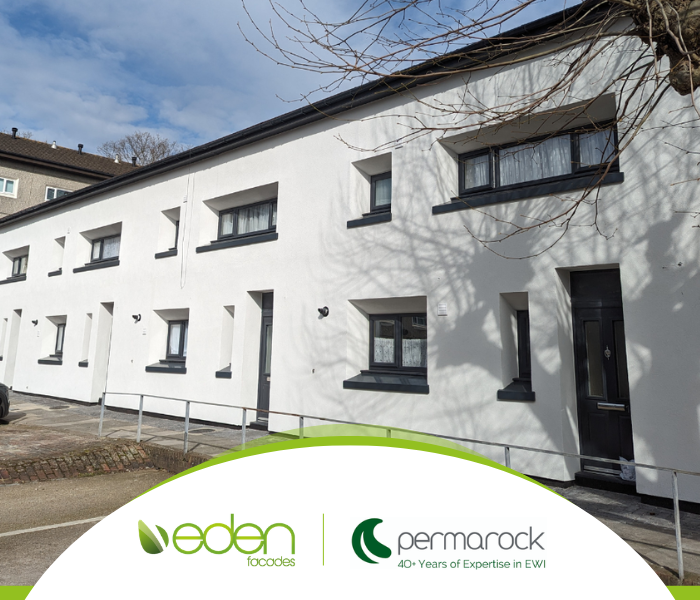
As façade solutions specialists, we’re accustomed to installing External Wall Insulation (EWI) systems to improve thermal performance, reduce energy use, and enhance building efficiency. When designed and installed effectively, EWI can provide a reliable, long-term solution that improves energy performance without sacrificing internal floor space.
As with any façade solution, there are many aspects to consider when specifying it to ensure optimal performance. This article explores how EWI systems help deliver consistent, high-quality outcomes.
Insights from Peter Wright, Senior Area Sales Manager at Permarock, and Tony Hill, Managing Director at Eden Facades
Why Detail Matters in EWI Design
EWI refers to a system where insulating materials are applied to the outside of a building and is widely used in refurbishment and decarbonisation projects for its thermal performance.
How the system performs depends on several factors, including how it integrates with the existing structure at junctions and openings, and how moisture is managed through the wall build-up. As Peter explains:
“Good façade design should ensure that the wall build-up is more vapour resistant on the warm side and increasingly vapour open towards the cold side, allowing moisture to diffuse outward through the construction.”
In simple terms, the wall must control the movement of warm, moist air while allowing excess moisture to escape safely. This includes ensuring that the overall system supports vapour diffusion in the correct direction, thereby reducing the likelihood of interstitial condensation within the wall.
When these principles are applied, EWI systems provide a proven and effective solution for improving energy efficiency, enhancing comfort, and supporting long-term building performance.
How EWI Design Influences Building Performance
The performance of an EWI system is closely linked to how well it is designed in relation to the wider building.
“It’s not just about the insulation itself – it’s about getting the design and detailing right so everything works together as it should,” adds Peter.
Maintaining continuous insulation around windows, floor edges, and structural junctions is essential. When these areas are properly detailed, internal surface temperatures remain more consistent, improving comfort and overall energy performance and eliminating cold bridging.
Moisture control is also a key consideration. The wall must manage how warm, moist air moves through the structure while allowing any incidental moisture to escape, supported by correctly positioned and sealed vapour control layers on new construction, particularly sheathed light gauge steel frames. Where this is not fully achieved, there is an increased risk of moisture accumulating within colder layers of the construction, so careful assessment of condensation risks, detailing and airtightness remain essential.
EWI also contributes to the building’s wider performance. Factors such as orientation, solar gain, and ventilation all play a role, so it is important to consider the building as a whole to achieve consistent and reliable results.
From Partial Upgrade to Consistent Performance
Taking a whole-building approach can make a measurable difference to performance outcomes and help avoid issues over time.
As Peter explains: “For example, if on a residential retrofit project, EWI was to be applied only to the front elevation as a cost-saving measure, this would potentially result in condensation on the uninsulated adjacent wall.
“This highlights the importance of considering the building as a complete envelope, as adjacent untreated areas can become more exposed to temperature variation. By extending the insulation strategy and refining junction detailing, a more consistent and stable internal environment would be achieved across the property.”
Key Considerations for EWI Performance
For EWI systems to perform effectively over time, several factors should be considered at the design, specification, and installation stages.
Vapour Control:
The wall build-up should manage moisture correctly, with any requisite vapour control layer positioned on the warm side and properly sealed to help limit the passage of warm, moist air into the construction. The vapour permeability of external layers should also be considered to ensure moisture can diffuse outward effectively. A condensation risk analysis should be carried out in all cases.
Insulation Continuity:
Insulation should remain continuous throughout the façade, particularly around window reveals, slab edges, parapets, and structural penetrations, to support consistent thermal performance.
Thermal Bridging:
Careful detailing at junctions is essential to reduce thermal bridging, maintain internal surface temperatures, and minimise the likelihood of localised condensation forming on colder areas.
Whole-Building Approach:
EWI performs best when considered as part of the wider building fabric, rather than in isolation, ensuring improvements in one area do not impact performance elsewhere. Ventilation and heating strategies are equally important.
Specification Accuracy:
The proposed system should be based on a clear understanding of the existing structure and wall build-up, particularly on refurbishment projects where further investigation or even structural remediation may be required before finalising the design.
Installation Quality:
High standards of installation are essential to ensure the system is fitted as intended, with close board joints, accurate fixing, well-formed junctions, and good airtightness throughout. Peter, adds:
“Permarock only supply systems via our extensive network of training, experienced Registered Installers, of which Eden Facades are a longstanding, and highly respected installer of Permarock in both the Retrofit and New-Build sectors.”
Air Movement Behind Insulation:
The build-up should avoid unintended air movement behind the insulation layer, as this can reduce its effective thermal performance and overall efficiency. Permarock systems are adhesively bonded and mechanically fixed with the adhesive effectively compartmentalising air behind the insulation, preventing thermal bypass.
Ground-Level Detailing:
System terminations should be carefully detailed above and below the damp-proof course and base of the wall to help manage moisture exposure, splashback, and long-term durability, particularly in areas exposed to repeated wetting.
The Role of Coordination and Delivery
While performance begins at the design stage, it is realised on site. Effective coordination between the designer, manufacturer, main contractor, and installer ensures that the system is delivered as intended.
As an approved installer of EWI systems, Eden Facades brings extensive experience across new-build and remediation projects, with a strong focus on buildability, detailing, and quality delivery.
“The success of any EWI system depends not just on high-quality products such as Permarock’s, but on how well it is detailed, coordinated, and installed on site. That’s where experience really matters,” adds Tony.
A Whole-Envelope Approach
Delivering consistent building performance requires a joined-up approach that considers the building as a complete system.
This includes managing moisture movement, maintaining insulation continuity, carefully detailing junctions, and delivering a high standard of installation. When these elements come together, EWI systems help maintain stable internal conditions, improve energy efficiency, and protect the structure over the long term.
It is also important to recognise that standard thermal calculations do not always reflect real-world performance. While U-values assess heat loss through flat surfaces, junctions may require more detailed analysis using linear thermal transmittance and temperature factor assessments to understand overall performance and the risk of condensation fully. In some cases, this may involve assessing junctions using temperature factor (fRsi) calculations to confirm internal surface conditions remain above the dew point.
By taking a whole-envelope approach, EWI systems can deliver reliable, consistent outcomes across a wide range of building types.
Performance, Not Just Compliance
As expectations around building efficiency continue to rise, façade design is increasingly focused on how buildings perform in use.
EWI systems, when designed and delivered effectively, contribute to buildings that are more comfortable, energy-efficient, and durable over time.
As Tony Hill concludes:
“We’re seeing a shift towards greater accountability for how buildings perform in use. Getting the façade right is central to that. It’s about delivering buildings that work for the people who live and use them, both now and in the future.”